
Gut Reaction #6: Why Is Original Sin Even A Thing?
It Just Takes One Guy With Bad Greek and Bad Guilt to Damn Us All

From Last Time:
…An example of this inadequate information: Well into adulthood, Augustine still felt guilty about his nocturnal emissions, which can be a problem in celibate religious houses. Of course, he wrote all about it. He festered and worried about his penis working the night shift, wondering if his free will was still operating while he was sleeping, thereby causing damnation-worthy erotic dreams and orgasms.
Because he didn’t know. He didn’t know about the subconscious mind, the nervous system, how the brain and body work. Instead, he instructed that wet dreams “spoke to all men, and of one thing alone — of a fatal deposit of concupiscence left there by Adam’s fall.” Eeeuww.
Episode #6
And yet so many authors praise Augustine for his wisdom about human nature. As far as it goes, for his time, sometimes, maybe. But part of the problem with Augustine’s knowledge of human nature is how he used it: He certainly knew what terror feels like, and had seen it in others many times. And yet he projected it onto humanity, crafting a terrifying theology of inborn eternal sin and damnation, and then having the nerve to note, “Very rarely, no never, does it happen that someone comes to us with the wish to be Christian who has not been struck by some fear of God” (On Catechizing the Uninstructed, 5.9). That fear has proven an effective sales funnel for Christianity for 1700 years, despite the fact that, as Prof. Bart Ehrman says in Misquoting Jesus, “Jesus never talks about a place of eternal conscious torment at all.” But Augustine does.
If Augustine were just some dyspeptic old fart venting in a basement apartment in Hippo, one could say he was a product of his times and let it go. But he was a popular bishop, and highly influential during his lifetime, writing, disseminating, and preaching thousands of still-referenced works. Augustine was later canonized a saint, named a Doctor of the Church, and is still considered the backbone of Western Christian thought.
He was also a macher, throwing his weight around with popes and at councils. He needed approval for his Original Sin idea, and spent years writing diatribes against a rival, the Celtic British theologian Pelagius, who believed humankind can avoid sinning and can freely choose to obey God's commandments. Prof. Peter Brown of Princeton (my kind of deity, who basically invented the study of Late Antiquity), explains that during the Pelagian controversy, Augustine wrote to the Pope, warning that accepting the Pelagian idea of freedom from original sin would mean “the Church would lose the vast authority it had begun to wield as the only force that could ‘liberate’ men from themselves.” Original Sin was subsequently adopted as doctrine, and confirmed a millennium later by the Council of Trent.
The early years of Christianity had sprouted many competing forms of considering Jesus—Arians, Gnostics, Marcionites, Donatists, Docetists, Nestorians, Pelagians, Eustathians, and more. Believers fought bloody battles in the street over whether Jesus and God were of the same substance, or whether Christianity was to include more Greek or Jewish influence. Was the key to the faith the life of Jesus? The death? The resurrection? There was no singular Christianity until Constantine intervened to calm public dissent and to begin consolidating beliefs, starting with the Council of Nicea of 325. (I am compelled to note that in addition to writing up the familiar Nicene Creed (“I believe in one God, the Father Almighty, maker of heaven and earth,” yada yada[1]) the participants at Nicea declared in Canon One—the first canon of the first-ever Church council—that a clergyman who is castrated by barbarians can still be a priest; but if he castrates himself, he’s out. Again with the balls. I don’t look for them, they just keep bobbing up.)
By Augustine’s generation—Nicea would have been during his grandfather’s age—a young “orthodox” Catholic Church was taking perhaps its first epically bad turn by adopting his Original Sin doctrine against other theologies, some harsher, some more mellow. A couple of earlier writers had circled the Original Sin idea, but Augustine made it stick.
Never mind that Augustine’s view was produced from a bad translation, bad logic, and persistent erections.
Augustine mistranslated one Greek preposition (eph ho) in Paul’s Romans 5:12 discussion of Adam’s disobedience. In Augustine’s version, instead of:
“…just as sin entered the world through one man, and death through sin, in this way death spread to all men, because all sin.”
the quote became,
“…death spread to all men, in whom all sin,” and included the rest of us in Adam’s act.
Augustine knew his version was incorrect; contemporaries warned him so. He didn’t care. He wasn’t good at Greek (he preferred Latin), so his source was an older Latin bible known for its mistranslations. There was a more accurate Latin bible, the Vulgate, just translated by his contemporary Jerome, that Augustine could have used. He didn’t. And he didn’t care. Perhaps he could see the potential.
Original sin was also a product of circular reasoning, which seems all too common in Christianity. First, it’s important for people unfamiliar with the One True Faith to understand that for Catholics, scripture is only half of revelation. The other half is “Sacred Tradition,” or practices and teachings believed to have been handed down from the Apostles via the succession of bishops (such as Augustine) and other theologians. In response, one of Luther’s Reformation battle cries was “Sola Scriptora” or “Scripture alone,” and “Sola Fide,” faith alone, as the basis of belief, which Catholicism rejects, especially since Catholicism predated by several centuries the standardization of the biblical canon. Sacred Tradition includes things I don’t get, like “the Deposit of Faith”: and more tangibly, the “elements of the Sacraments” (the specific words and actions that make them “work,” aka the hocus pocus. Really—the officiant needs to say the right words or it doesn’t work. In 2022, the Diocese of Phoenix, Arizona announced that everyone who over the past 20 years had been baptized by a particular priest had to hurry up and get baptized again. The priest had pronounced “We baptize you…” instead of “I baptize you...” He thought he was speaking on behalf of the whole Church, but sacramentally, the priest speaks on behalf of Jesus, who evidently really cares about pronouns).
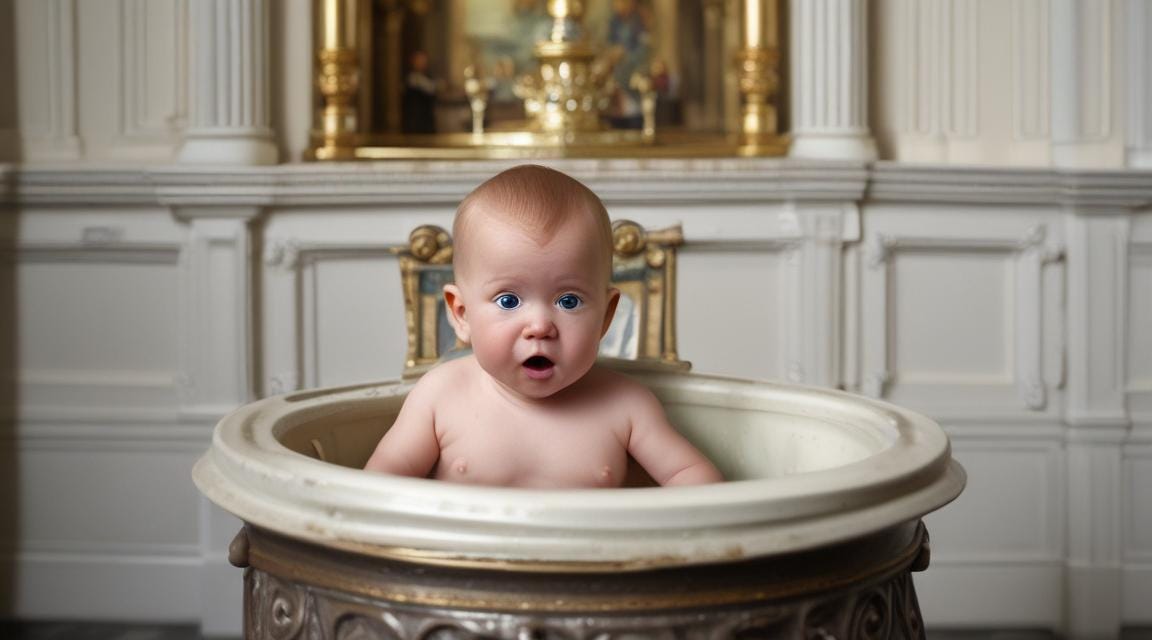
Augustine knew, of course, that Christians baptized babies. Other cults of the time also immersed believers in water to signify rebirth or readiness for some new station. Augustine noted that Jesus had been baptized, which Yahweh had approved by claiming Jesus as his son, so Augustine reasoned it must be good for Christians to be baptized.
So: God and Jesus approve of baptism, and Augustine knows the Church’s tradition is to baptize babies. But why does the Church baptize babies? What sins have they committed? None, of course, says Augustine. (Although he considered the clutching of an infant at its mother’s breast as inborn avarice instead of mere survival. Sometimes it helps to remember you’re a mammal.) Babies haven’t sinned, he knew, but since the Church is always correct, surely it has a perfect, godly reason it baptizes babies…therefore, he says:
“That man is born with sin is shown from the baptism of infants…[and] from the words of the Apostle to the Romans and the Corinthians.”
Proof! We are born with Original Sin because the Church already had that size sacrament in stock, and because someone said so in a bad translation.
A more recent, presidential example of this kind of logic: “The news is fake because so much of the news is fake.”
Next time: And All Those Erections Must Mean Something...
[1] I believe in one God,
the Father almighty,
maker of heaven and earth,
of all things visible and invisible.
I believe in one Lord Jesus Christ,
the Only Begotten Son of God,
born of the Father before all ages.
God from God, Light from Light,
true God from true God,
begotten, not made, consubstantial with the Father;
through him all things were made.
For us men and for our salvation
he came down from heaven,
and by the Holy Spirit was incarnate of the Virgin Mary,
and became man.
For our sake he was crucified under Pontius Pilate,
he suffered death and was buried,
and rose again on the third day
in accordance with the Scriptures.
He ascended into heaven
and is seated at the right hand of the Father.
He will come again in glory
to judge the living and the dead
and his kingdom will have no end.
I believe in the Holy Spirit, the Lord, the giver of life,
who proceeds from the Father and the Son,
who with the Father and the Son is adored and glorified,
who has spoken through the prophets.
I believe in one, holy, catholic and apostolic Church.
I confess one Baptism for the forgiveness of sins
and I look forward to the resurrection of the dead
and the life of the world to come. Amen.